

Selbstbildnis am Tisch
Künstler:in
Käthe Kollwitz
(1867 - 1945)


Dateum 1893
MediumRadierung und Aquatinta
Display DimensionsBlatt: 34,8 cm × 26,1 cm (348 × 261 mm)
Platte: 17,8 cm × 12,8 cm (178 × 128 mm)
Platte: 17,8 cm × 12,8 cm (178 × 128 mm)
ClassificationsDruckgrafik
Credit LineMuseum der Moderne Salzburg
Object numberBA 5239
Provenance1984 Ankauf
Collections
Bibliography
- ÖKat Sal MdM 597Die Sammlungen : Spielen heißt verändern! Freies Spiel der Kräfte. Räume öffnen! Der Raum in unseren KöpfenMünchenHirmer2024310-311illustrated
- ÖKat Sal MdM 598The collections : Playing rules! Breaking free. Breaking down walls! Body spaceMünchenHirmer2024310-311illustrated
Zu den bedeutendsten Künstler:innen des 20. Jahrhunderts,
deren Leben und Werk eng mit der politischen Entwicklung
Deutschlands verknüpft war, zählt heute mit Fug und Recht
Käthe Kollwitz. „Ich war revolutionär, mein Kindheits- und
Jugendtraum war Revolution und Barrikade“, notierte sie im
Oktober 1920 in ihr Tagebuch. Die Künstlerin verdankte
ihr politisches und soziales Engagement ihrem sozialistischen
Elternhaus; durch ihren Mann, einem Kassenarzt im Berliner
Arbeiterbezirk Prenzlauer Berg, lernte sie später das Leid
Armutsbetroffener kennen.
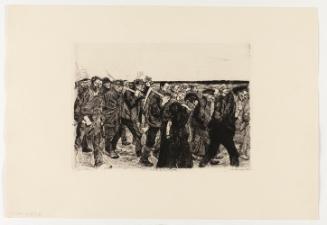
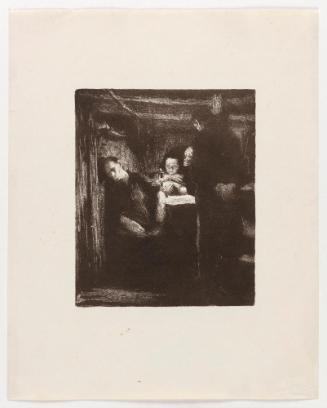
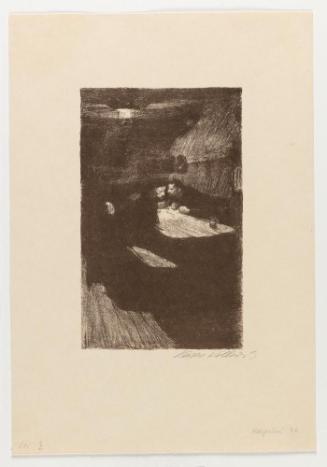
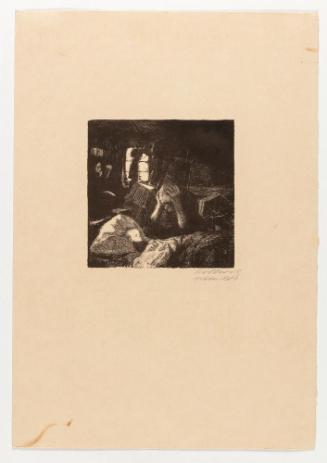
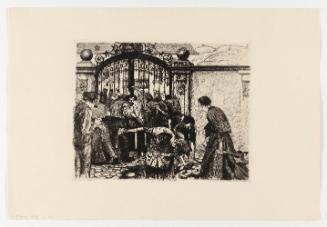
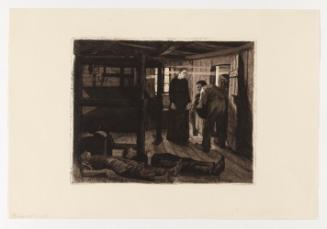
In ihrer Grafikfolge geht es daher nicht wie in Gerhard
Hauptmanns Drama „Die Weber“ um den historischen Weberaufstand
von 1844, vielmehr überträgt Kollwitz das Sujet mutig
auf die Gegenwart und die sozialen Probleme ihrer Zeit.
Auffallend ist, dass Frauen sowohl am Demonstrationszug der
Weber als auch beim Sturm auf die Villa des Fabrikanten
teilnehmen und die Künstlerin sie prominent in den Blattvordergrund
platziert. Obwohl Kaiser Wilhelm II. ihr 1898 auf der
Großen Berliner Kunstausstellung eine Medaille verweigern
sollte, gelang ihr mit dieser virtuos umgesetzten Grafikfolge
der künstlerische Durchbruch. (Barbara Herzog)
Today Käthe Kollwitz, the life and work of whom is closely connected to Germany’s political development, is justifiably considered one of the most significant artists of the twentieth century. “I was a revolutionary. Revolution and barricades were the dream of my childhood and youth,” wrote Kollwitz in her diary in October 1920. The artist credited her political and social engagement to her socialist parents. Through her husband, a doctor in the Berlin district of Prenzlauerberg, she was also exposed to the suffering of the working class. The artist’s drawing series is not a reference to Gerhard Hauptmann’s drama “Die Weber” (The Weavers) concerning the historical Weavers’ Revolt of 1844, but a courageous exploration of the present and the social problems of her time. Strikingly, women were participants in both the weavers’ demonstration and the storming of the industrialist’s villa, and the artist positions them prominently in the foreground of the print. Although Kaiser Wilhelm II is said to have refused her a medal at the Great Berlin Art Exhibition in 1898, this virtuoso series of prints led her to an artistic breakthrough. (Barbara Herzog)