Rainforest V (Variation 2)
Künstler:in
David Tudor & Composers Inside Electronics
(gegründet 1973)


Date1973/2015
Medium20 Objekte, jeweils mit eigenem Geräuscharchiv
ClassificationsSkulpturen, Objekte, Installationen
Credit LineMuseum der Moderne Salzburg – angekauft mit Mitteln der Generali Foundation
Museum der Moderne Salzburg—Purchased with funds by Generali Foundation
Object numberBA 17173_1-20
Provenance2015 Ankauf
About the workIn 1950, the pianist and composer David Tudor delivered the American premiere of Pierre Boulez’s "Deuxième Sonate pour Piano" (Second Piano Sonata, 1947) at Carnegie Recital Hall, New York. Its success launched him into the international spotlight and earned him a position among a group of experimental composers, including John Cage with whom Tudor established a lifelong collaboration. Together they developed musical notation methods based on indeterminacy and atypical use of instruments. In the early 1960s, Tudor and Cage initiated a trend toward "live" electronic composition.
The work "Rainforest" was realized by Tudor as a commission in 1968 for the Merce Cunningham Dance Company. He used a number of table-top objects through which sounds were driven and then re-amplified to create a live musical composition for the dance. "Rainforest" was performed over one hundred and forty times with the Cunningham repertory company and featured Andy Warhol’s "Silver Clouds" (1966) as an interactive stage set.
After two more variations, which Tudor produced together with Cage, he created "Rainforest IV" in collaboration with other artists and musicians at the "New Music in New Hampshire" festival in 1973. For this version, Tudor used large objects that hung in a space with resonances amplified through a loudspeaker system. This original group included: John Driscoll, Phil Edelstein, Linda Fisher, Martin Kalve, Ralph Jones, Greg Kramer, Susan Palmer, and Bill Viola. The first public performance of the installation, titled "Sliding Pitches in the Rainforest in the Field" lasted six hours and was continuously attended by audiences who walked around in wonder and listened to experience the spatial-sound dimension of the work. This workshop eventually led to the formation of the collective Composers Inside Electronics (CIE), which to this day has an extensive performance and exhibition history. CIE continues Tudor’s legacy with ongoing installations and performances of the various "Rainforest" versions and other Tudor compositions.
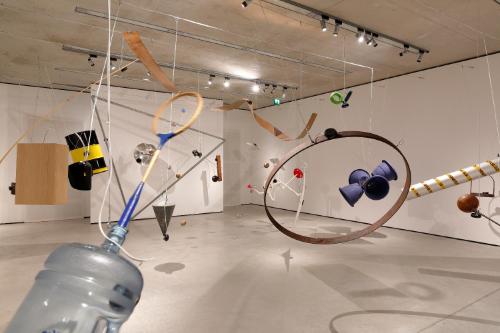
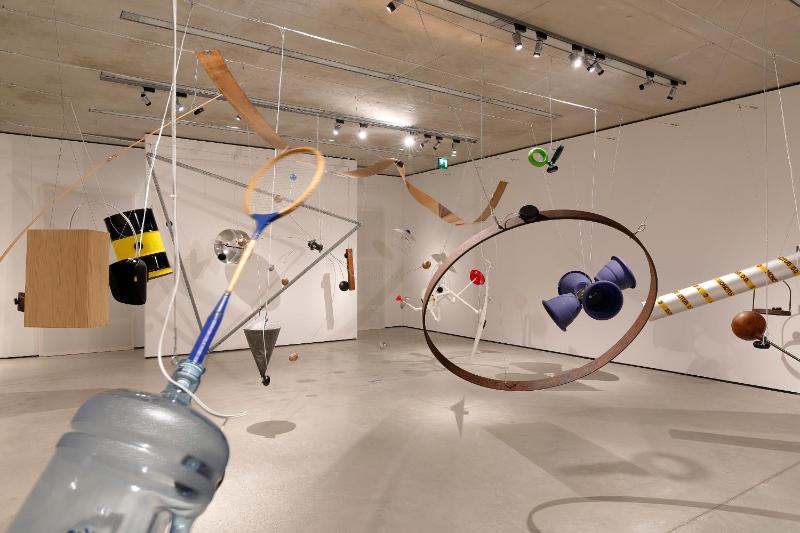
Tudor’s "Rainforest" lives on in the newest member of the family of works, "Rainforest V," a self-playing variant of which variations are in the collections of the Museum of Modern Art in New York, the Museum der Moderne Salzburg, the Musee d'art contemporain de Lyon, and the Arter in Istanbul. Visitors are encouraged to touch the objects and listen to the sounds that are transmitted through them, and participate like this in the sound space of the rainforest. [Christina Penetsdorfer, 2022]
1950 präsentierte der Pianist und Komponist David Tudor die amerikanische Premiere von Pierre Boulez’ „Deuxième Sonate pour Piano" (Zweite Klaviersonate, 1947) in der Carnegie Recital Hall, New York. Mit diesem Auftritt erlangte er internationalen Erfolg und reihte sich in eine Gruppe experimenteller Komponisten ein – unter ihnen John Cage, mit dem Tudor sein Leben lang zusammenarbeiten sollte. Gemeinsam entwickelten sie Methoden der Notenschrift, die auf Unbestimmtheit und dem ungewöhnlichen Einsatz von Instrumenten beruhen. In den frühen 1960er-Jahren initiierten Tudor und Cage „live" elektronische Kompositionen.
Das Werk „Rainforest" (Regenwald) realisierte Tudor 1968 als Auftragsarbeit für die Merce Cunningham Dance Company. Dabei dienten Klänge, die durch einige auf einem Tisch befindliche Gegenstände geleitet und verstärkt wurden, als Soundtrack für die gleichnamige Choreografie. Das Stück wurde mehr als hundertvierzig Mal mit der Cunningham-Repertoire-Truppe aufgeführt. Als interaktives Bühnenbild dienten unter anderem die „Silver Clouds" (Silberwolken, 1966) von Andy Warhol.
Nach zwei weiteren Versionen, die Tudor zusammen mit John Cage produzierte, entstand 1973 „Rainforest IV" in Zusammenarbeit mit anderen Künstler:innen und Musiker:innen für das Festival „New Music in New Hampshire". Tudor verwendete dafür große hängende Objekte, durch die spezifische für die jeweiligen Gegenstände ausgewählte oder entwickelte Töne geleitet wurden. Zu der ursprünglichen Gruppe gehörten John Driscoll, Phil Edelstein, Linda Fisher, Martin Kalve, Ralph Jones, Greg Kramer, Susan Palmer und Bill Viola. Die erste öffentliche performative Bespielung der Installation, die den Titel „Sliding Pitches in the Rainforest in the Field" (Gleitende Tonleitern im Regenwald im Feld) trug, dauerte sechs Stunden und war ununterbrochen von Publikum besucht, das staunend und lauschend umherging, um die räumlich-klangliche Dimension des Werks zu erleben. Aus diesem Workshop ging schließlich die Gründung des Kollektivs Composers Inside Electronics (CIE) hervor, das bis heute eine umfangreiche Performance- und Ausstellungshistorie aufweisen kann. CIE trägt Tudors Vermächtnis mit fortlaufenden Installationen und Performances verschiedener Versionen von „Rainforest" und anderen Kompositionen weiter.
Tudors „Rainforest" lebt im jüngsten Mitglied der Werkfamilie fort, in „Rainforest V", eine selbstspielende Variante, von der sich Variationen in den Sammlungen des Museum of Modern Art in New York, des Museum der Moderne Salzburg, des Musee d’art contemporain de Lyon und des Arter in Istanbul befinden. Besucher:innen können mit der raumgreifenden Soundinstallation interagieren, indem sie ihr Ohr an die Objekte legen und so den Klangraum des Regenwaldes in seinem breiten Spektrum erfahren. [Christina Penetsdorfer, 2022]
Bibliography
- K Tud 2David Tudor and Composers Inside Electronics, Inc. (John Driscoll and Phil Edelstein) : Rainforest V (variation 3)IstanbulArter2021
- DKat Kre Kun-Mus 3On Air : Sound als Material in der Kunst der 1950er bis 1970er Jahre = The sound of the material in the art of the 1950s to 1970sBerlinDCV2022222-227illustrated