(RE-)CREATION
Künstler:in
Jojo Gronostay
geboren 1988

Date2021
MediumZweikanal-Projektion, 2 Ultra-High-Definition Videos (Farbe, Stereosound)
ClassificationsMedienkunst
Credit LineMuseum der Moderne Salzburg – Ankauf aus Mitteln der Galerienförderung des Bundes
On View
Not on viewObject numberMA 154
Provenance2021 Ankauf
Collections
- Neuzugänge der vergangenen fünf Jahre
DepartmentFotografie und Medienkunst
About the work
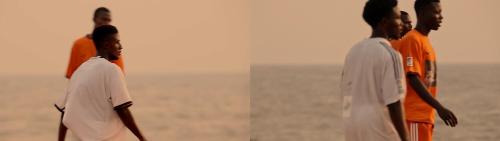
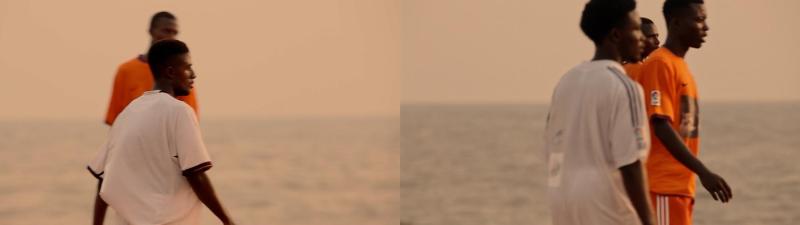
Jojo Gronostay is a young German artist with Ghanaian roots who focuses on issues of postcolonial hybridity, the scandalous asymmetries of European-African relations, fashion, recycling, and appropriation in his work. His 2021 film "(RE-)Creation", shot on the coast of Accra, the capital of the West African country of Ghana, shows a soccer match against a sea backdrop. Young men play in the jerseys of top European clubs, and various close-ups of the players reveal that their soccer jerseys are branded with the label DWMC (for “Dead White Men’s Clothes”). When Western second-hand fashion arrived in Ghana in the 1970s, the local population referred to it as the clothes of dead white men—and it is precisely this asymmetric circulation of goods and people that Gronostay addresses in his film. The Kantamanto Market in Accra is by now one of the largest hubs for second-hand clothing from Asia, Europe, North America, and Australia.
Right by the sea, a game takes place of young black men who carry their hopes on their skin, as it were, yet at the same time there seems to be no real escape from this global game plan. The beach of Accra looks like industrial wasteland, and in the background the Independence Arch, built in 1957 to mark Ghana’s independence, rises as a disillusionistic architectural icon. [Thorsten Sadowsky, 2022]
Right by the sea, a game takes place of young black men who carry their hopes on their skin, as it were, yet at the same time there seems to be no real escape from this global game plan. The beach of Accra looks like industrial wasteland, and in the background the Independence Arch, built in 1957 to mark Ghana’s independence, rises as a disillusionistic architectural icon. [Thorsten Sadowsky, 2022]
Jojo Gronostay ist ein junger deutscher Künstler mit ghanaischen Wurzeln, der sich in seinem Werk mit postkolonialer Hybridität, den skandalösen Asymmetrien der europäisch-afrikanischen Beziehungen sowie mit Mode, Recycling und Appropriation beschäftigt. Sein Film „(RE-)Creation" (2021), der an der Küste Accras, der Hauptstadt des westafrikanischen Landes Ghana, aufgenommen wurde, zeigt ein Fußballspiel vor Meereskulisse: Junge Männer spielen in den Trikots europäischer Spitzenclubs, und bei verschiedenen Close-ups der Spieler wird deutlich, dass ihre Fußballshirts mit dem Label DWMC (steht für „Dead White Men’s Clothes“) gebrandet sind. Als westliche Secondhand-Mode in den 1970er-Jahren Ghana erreichte, wurde sie von der Bevölkerung als Kleidung von toten weißen Männern bezeichnet – und es ist genau diese asymmetrische Zirkulation von Waren und Menschen, die Gronostay in seinem Film adressiert. Mittlerweile ist der Kantamanto Market in Accra einer der größten Umschlagspunkte für Secondhand-Kleidung aus Asien, Europa, Nordamerika und Australien.
Am Meeressaum findet ein Spiel junger Schwarzer Männer statt, die ihre Hoffnungen gewissermaßen am Leib tragen, und zugleich scheint es aus diesem globalen Spielplan kein wirkliches Entrinnen zu geben. Die Gegenwart am Strand von Accra hat den Charakter einer industriellen Brachlandschaft, und im Hintergrund erhebt sich als desillusionistische Architekturikone der Independence-Arch, der 1957 zur Unabhängigkeit Ghanas erbaut wurde. [Thorsten Sadowsky, 2022]
Am Meeressaum findet ein Spiel junger Schwarzer Männer statt, die ihre Hoffnungen gewissermaßen am Leib tragen, und zugleich scheint es aus diesem globalen Spielplan kein wirkliches Entrinnen zu geben. Die Gegenwart am Strand von Accra hat den Charakter einer industriellen Brachlandschaft, und im Hintergrund erhebt sich als desillusionistische Architekturikone der Independence-Arch, der 1957 zur Unabhängigkeit Ghanas erbaut wurde. [Thorsten Sadowsky, 2022]