Second Nature
Künstler:in
Georgia Creimer
geboren 1964

Date1998
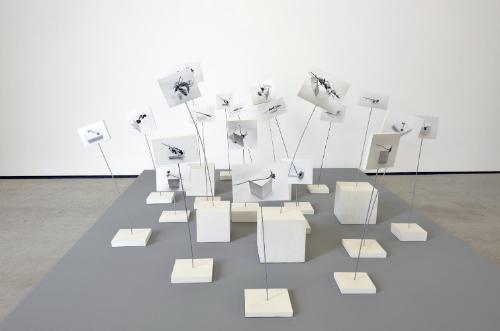
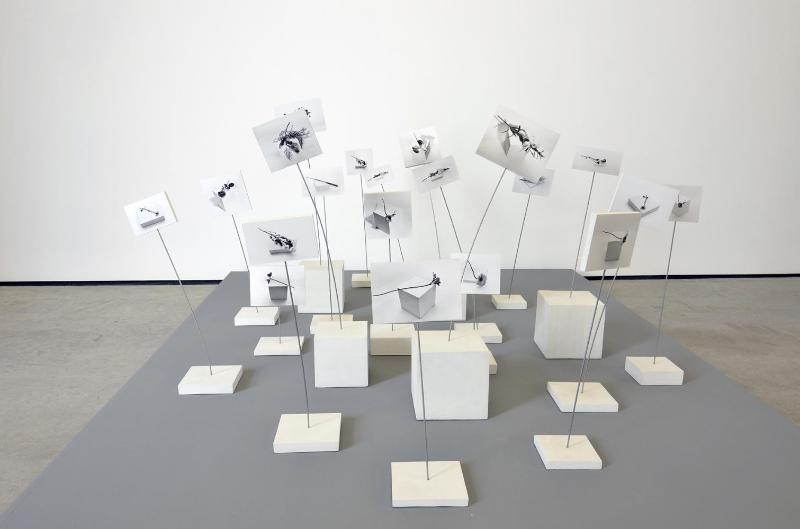
MediumSchwarz-Weiß-Fotografien auf Polystyrolplatten, Gipssockel und -plinthen, Alustäbe
Display DimensionsFoto: 8 x 17 cm
Foto: 16 x 20 cm
Foto: 16 x 20 cm
ClassificationsSkulpturen, Objekte, Installationen
Credit LineFotosammlung des Bundes am Museum der Moderne Salzburg
Object numberDLF 1414_1-20
Provenance2000 Dauerleihgabe
DepartmentFotosammlung des Bundes
About the workGeorgia Creimers künstlerische Arbeiten bestechen durch
die Fülle an formalen und inhaltlichen Zugängen. Die seit 1986
in Wien lebende brasilianische Künstlerin verbindet in ihrem
Schaffen so unterschiedliche Medien wie Fotografie, Objekt und
Installation. Für „Second Nature“ montierte sie Schwarz-Weiß-
Fotografien von Pflanzen auf biegsame Aluminiumstäbe und
überführt die dreidimensionale Vorlage ins Zweidimensionale,
um sie schlussendlich wieder in eine raumgreifende Anordnung
münden zu lassen.
Das sich sanft im Luftzug bewegende Gestänge verweist auf die eng verflochtene Beziehung zwischen Mensch, Kunst und Natur und öffnet eine Vielzahl von Assoziationsräumen: Die dekorativ auf kleinen Sockeln drapierten Blüten und Gräser können als Symbole für die Schönheit und ihre rasche Vergänglichkeit gelesen werden. Ihre Erhöhung auf Podesten persifliert philosophische Denkmodelle des Erhabenen in der Natur. Der Begriff „Zweite Natur“ spielt wiederum auf festgefahrene Gewohnheiten an, die das ursprüngliche Wesen eines Menschen überlagern und schließlich ersetzen. Es stellt sich die Frage, ob der Anblick der Installation dieselben Empfindungen auslöst wie der Anblick einer realen Blumenwiese. Sollte dem so sein, dann wäre uns Creimers Surrogat zur zweiten Natur geworden. [Barbara Herzog, 2024]
Das sich sanft im Luftzug bewegende Gestänge verweist auf die eng verflochtene Beziehung zwischen Mensch, Kunst und Natur und öffnet eine Vielzahl von Assoziationsräumen: Die dekorativ auf kleinen Sockeln drapierten Blüten und Gräser können als Symbole für die Schönheit und ihre rasche Vergänglichkeit gelesen werden. Ihre Erhöhung auf Podesten persifliert philosophische Denkmodelle des Erhabenen in der Natur. Der Begriff „Zweite Natur“ spielt wiederum auf festgefahrene Gewohnheiten an, die das ursprüngliche Wesen eines Menschen überlagern und schließlich ersetzen. Es stellt sich die Frage, ob der Anblick der Installation dieselben Empfindungen auslöst wie der Anblick einer realen Blumenwiese. Sollte dem so sein, dann wäre uns Creimers Surrogat zur zweiten Natur geworden. [Barbara Herzog, 2024]
Georgia Creimer’s art captivates with its abundance of content
and formal approaches. The Brazilian artist, who has lived
in Vienna since 1986, combines a variety of media in her work
including photography, objects, and installations. For “Second
Nature”, she mounted black-and-white photographs of plants on
flexible aluminum rods, transferring the three-dimensional
model into the two-dimensional and ultimately channeling it
back into a space-filling structure.
The rods move gently in the breeze and reference the close relationship between humans, art, and nature, opening up a multitude of associative spaces: The flowers and grasses, spread out decoratively on small pedestals, can be read as symbols of beauty and its ephemerality. Their elevation on pedestals satirizes philosophical notions of the sublime in nature. The phrase “second nature,” on the other hand, refers to the entrenched habits that overlay, and ultimately replace, a human being’s original nature. It asks us: Does the sight of the installation evoke the same feelings as the sight of a real wildflower meadow? If it does, then Creimer’s surrogate would become second nature to us. [Barbara Herzog, 2024]
The rods move gently in the breeze and reference the close relationship between humans, art, and nature, opening up a multitude of associative spaces: The flowers and grasses, spread out decoratively on small pedestals, can be read as symbols of beauty and its ephemerality. Their elevation on pedestals satirizes philosophical notions of the sublime in nature. The phrase “second nature,” on the other hand, refers to the entrenched habits that overlay, and ultimately replace, a human being’s original nature. It asks us: Does the sight of the installation evoke the same feelings as the sight of a real wildflower meadow? If it does, then Creimer’s surrogate would become second nature to us. [Barbara Herzog, 2024]
Bibliography
- ÖKat Sal MdM 582The Collections : Breaking down walls!SalzburgMuseum der Moderne Salzburg202422
- ÖKat Sal MdM 597Die Sammlungen : Spielen heißt verändern! Freies Spiel der Kräfte. Räume öffnen! Der Raum in unseren KöpfenMünchenHirmer2024192-193illustrated
- SKat 251The Collections : Breaking down walls!SalzburgMuseum der Moderne Salzburg202422
- ÖKat Sal MdM 581Die Sammlungen : Räume öffnen!SalzburgMuseum der Moderne Salzburg202422
- SKat 250Die Sammlungen : Räume öffnen!SalzburgMuseum der Moderne Salzburg202422
- SKat 255The collections : Playing rules! Breaking free. Breaking down walls! Body spaceMünchenHirmer2024192-193illustrated
- ÖKat Sal MdM 598The collections : Playing rules! Breaking free. Breaking down walls! Body spaceMünchenHirmer2024192-193illustrated
- SKat 254Die Sammlungen : Spielen heißt verändern! Freies Spiel der Kräfte. Räume öffnen! Der Raum in unseren KöpfenMünchenHirmer2024192-193illustrated