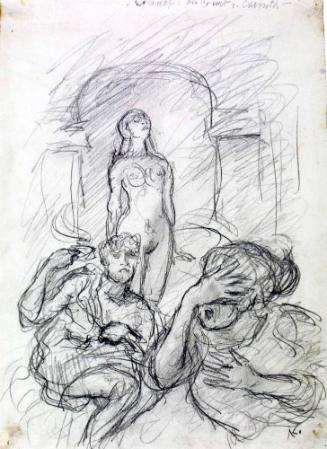
Die Braut von Korinth


Darstellung: 36,2 × 28 cm (362 × 280 mm)
Alfred Kubin’s composition refers to Johann Wolfgang von Goethe’s 1979 ballad of the same title, in which the poet limned a vampire that did not match how his time envisioned such figures. Rather than a bloodthirsty monster, the bride of Corinth is a fair young woman.
A youth from Athens has arrived at a Corinthian family’s house, expecting to bring the bride to whom he was betrothed as a child back to his city. Yet the girl has since died, consumed by grief because, after her family’s conversion to Christianity, she was condemned to a life of chastity. Night falls, and the dead bride returns to her parents’ home as a revenant:
“Nightly from my narrow chamber driven,
Come I to fulfil my destined part.
Him to seek to whom my troth was given,
And to draw the life-blood from his heart.”
The print shows the scene in which the mother breaks in upon the lovers and the young man realizes that he will die.
“Fair young man! thy thread of life is broken.
Human skill can bring no aid to thee.
There thou hast my chain—a ghastly token—
And this lock of thine I take with me.
Soon must thou decay,
Soon thou wilt be gray,
Dark although to-night thy tresses be!”
[Barbara Herzog, 2022]
Alfred Kubins Darstellung bezieht sich auf Johann Wolfgang von Goethes gleichnamige Ballade aus dem Jahr 1797, in der der Dichter eine Vampirgestalt schuf, die nicht den gängigen Vorstellungen seiner Zeit entsprach. An die Stelle eines blutrünstigen Monsters tritt eine junge schöne Frau.
Ein Jüngling aus Athen kehrt bei einer korinthischen Familie ein, um die ihm versprochene Braut zu sich nach Hause zu holen. Doch in der Zwischenzeit ist das Mädchen aus Gram gestorben, weil es nach dem Übertritt der Familie zum Christentum verpflichtet war, ein Leben in Keuschheit zu führen. In der Nacht kehrt die Tote als Wiedergängerin in das Elternhaus zurück.
"Aus dem Grabe werd ich ausgetrieben,
Noch zu suchen das vermißte Gut,
Noch den schon verlohrnen Mann zu lieben,
Und zu saugen seines Herzens Blut."
Das Blatt zeigt die Szene, in der die Mutter die Liebenden überrascht und dem jungen Mann klar wird, dass er sterben wird.
"Schöner Jüngling, kannst nicht länger leben,
Du versiechest nun an diesem Ort,
Meine Kette hab ich dir gegeben;
Deine Locke nehm ich mit mir fort.
Sieh sie an genau,
Morgen bist du grau,
Und nur braun erscheinst du wieder dort."
[Barbara Herzog, 2022]