But all they found were tide lines I
- Neuzugänge der vergangenen fünf Jahre - Ursprünglich besessen von lnievers
But all they found were tide lines
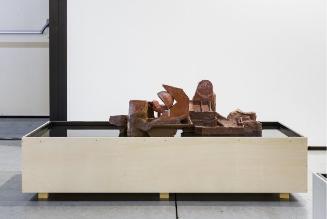
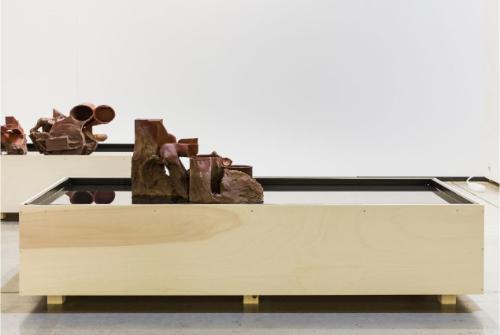
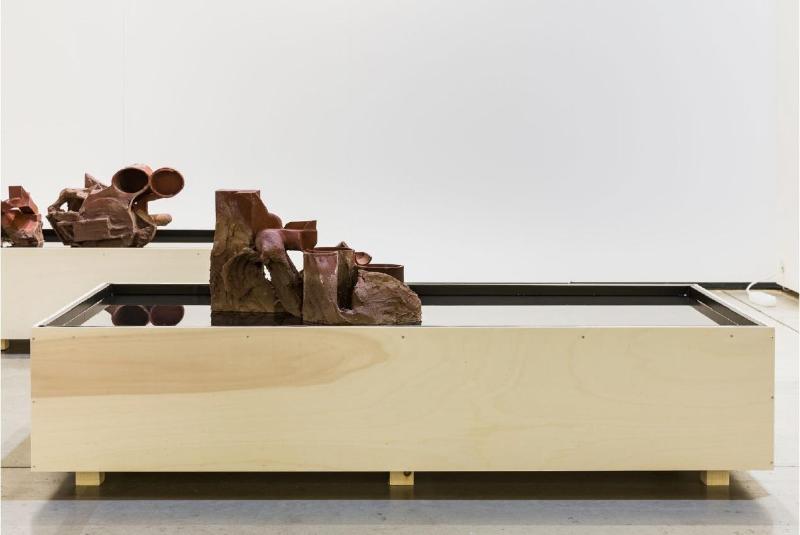
The series But all they found were tide lines consist of troughs on the floor, in which ceramics are placed. the almost coffin sized pedestals are an integral part of the the work and contain salt water which enables a reaction in Sturla’s high fired ceramic works, rendering the works as time based pieces. Through his experiments in the studio he understood that high fired ceramics, despite their vitrification are still porous enough to allow from of osmosis to happen as the ceramic sit in water. Over the duration of the exhibition, the works are developing and changing and absorbing some of the salty water solution, and as a result they sweat out salt crystals. The base of the objects is coated with a clay and mineral solution, which, over the course of the show, will crumble and disintegrate.
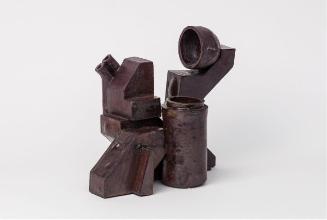
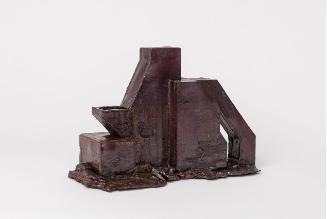
The visual language of the ceramic sculptures is teetering and seems to be part industrial, mechanical, part car engine, part architecture. They illustrate the fallacy between technological precision and our (in)ability to recall and visually digest space, function or logic.
Sturla, fascinated by history and archaeology, thinks about how we understand previous societies and civilizations by reconstructing fragments, utilizes leftovers form archaeological dig sites, his practice is driven by questions how an image of a society can be built from sicarded and broken bits of debris.
The historically charged medium of clay is relevant to this as one of the oldest materials whose limits and potential Sturla explores and exhausts in his work process. The sculptures of the "Past Ones Preserved" (2020) series, for example, were exposed to extremely high temperatures during the firing process until their surfaces cracked, began to melt, and eventually were put into an amorphous form.
Even when fired, ceramics function as a kind of chronometer, as they continue to gain mass by absorbing ambient humidity and, consequently, are datable. In "But All They Found Were Tide Lines" (2020), Sturla takes advantage of this material property. For the duration of the exhibition, the clay soaks up the water in the basins and “sweats” the salt out into a crust that encloses the ceramics, imposing weight and thus history on them. The boundaries between recent and pseudo-archaeological past begin to dissolve and coincide with the present—what is true and what is a myth? [Marijana Schneider, 2022]
Relevant ist dafür das historisch vielfach aufgeladene Material Ton als einer der ältesten Werkstoffe, dessen Grenzen und Potential Sturla in seinem Arbeitsprozess erforscht und ausreizt. So setzte er die Skulpturen der Serie „Past ones preserved" (2020) beim Brennprozess außergewöhnlich hohen Temperaturen aus, bis ihre Oberflächen rissig wurden, sie zu schmelzen begannen und letztendlich in einer amorphen Gestalt gebannt wurden.
Auch in gebranntem Zustand fungieren Keramiken als eine Art Zeitmesser, da sie durch die Absorption von Luftfeuchtigkeit weiterhin an Masse gewinnen und somit datierbar sind. Mit der Arbeit „But all they found were tide lines" (2020) macht sich Sturla diese Materialeigenschaft zunutze. Über die Dauer der Ausstellung saugt der Ton das Wasser in den Becken auf und „schwitzt“ das Salz zu einer Kruste aus, welche die Keramiken umschließt und ihnen Gewicht und somit Geschichte aufzwingt. Die Grenzen zwischen der jüngsten und der pseudoarchäologischen Vergangenheit beginnen sich aufzulösen und fallen mit der Gegenwart zusammen – was ist wahr und was ist ein Mythos? [Marijana Schneider, 2022]