For copyright reasons, we are unfortunately not allowed to reproduce this work
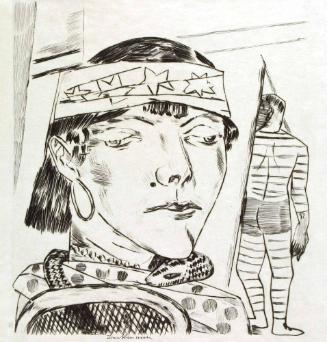
for Der Jahrmarkt
Der Jahrmarkt
Künstler:in
Max Beckmann
1884 – 1950


Date1921; publ. 1922
MediumMappe mit 10 Kaltnadelradierungen
Display DimensionsBlatt: 54,4 cm × 39 cm (544 × 390 mm)
Blatt: 41 cm × 25 cm (410 × 250 mm)
Blatt: 41 cm × 25 cm (410 × 250 mm)
ClassificationsDruckgrafik
Credit LineMuseum der Moderne Salzburg – Schenkung von Alette Sigmundt
Museum der Moderne Salzburg – Donation by Alette Sigmundt
Object numberBS 3549_1-10
Provenance1982 Schenkung von Alette Sigmundt, Salzburg
DepartmentGrafische Sammlung, Gemälde und Skulpturen
About the workVolunteering for service as a medic, Max Beckmann witnesses the horrors of the First World War and suffers a severe nervous breakdown. The experience leaves him burning to “record the unspeakable aspects of life […] and pen them up in crystal-clear sharp lines and surfaces, to force them down, to strangle them.” During the political turbulence of the postwar years, he creates the four cycles of prints that are his chief works in the medium.
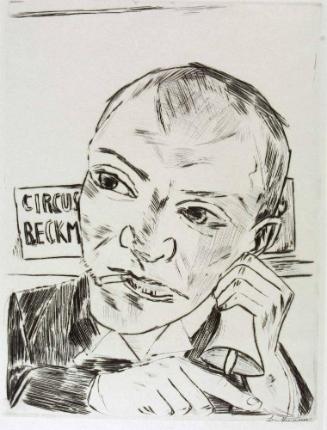
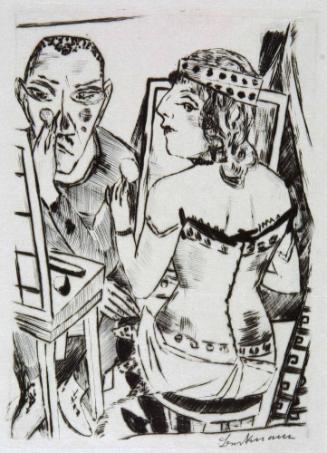
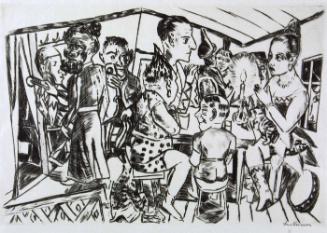
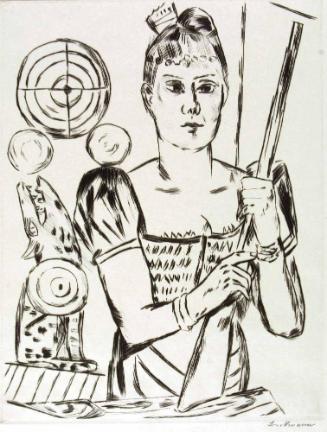
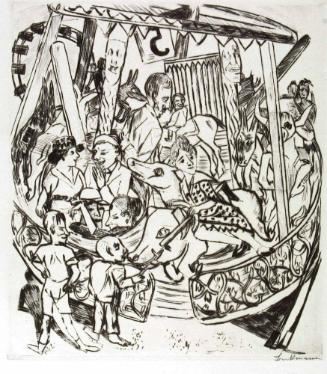
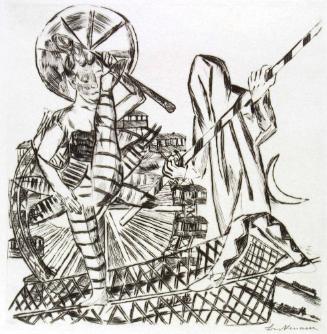
In the series of drypoint etchings published in 1922, Beckmann himself appears as the barker inviting the beholders to a stroll through the funfair or (as the sign in the background reveals) “Beckmann’s Circus.” To the artist, both circus and fair are allegories of life: the masquerade makes manifest the role-play that is society.
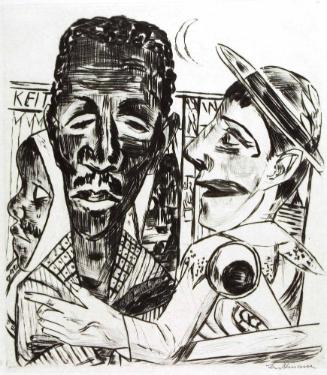
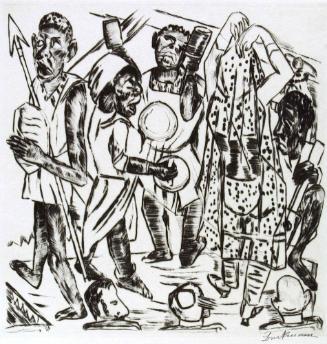
Max Beckmann chooses titles for two prints in the graphic-art series “The Annual Fair” that we no longer use today because they are racist and discriminatory.
Carl Hagenbeck, a German merchant of animals, first comes up with the idea of enriching the display of exotic animals in zoos with humans from the German colonies in Africa. It proves to be a successful business model. Between 1874 and 1931, around four hundred “ethnic shows” are held in Germany alone. They play a key role in the dissemination of racist prejudices.
N**** is a racist label that has been in use in the German-speaking countries since the colonial era. It is derogatory and used to other, exclude, and disparage people with certain ancestries by contrast with an allegedly white “normal population.” [Barbara Herzog, 2025]
In the series of drypoint etchings published in 1922, Beckmann himself appears as the barker inviting the beholders to a stroll through the funfair or (as the sign in the background reveals) “Beckmann’s Circus.” To the artist, both circus and fair are allegories of life: the masquerade makes manifest the role-play that is society.
Max Beckmann chooses titles for two prints in the graphic-art series “The Annual Fair” that we no longer use today because they are racist and discriminatory.
Carl Hagenbeck, a German merchant of animals, first comes up with the idea of enriching the display of exotic animals in zoos with humans from the German colonies in Africa. It proves to be a successful business model. Between 1874 and 1931, around four hundred “ethnic shows” are held in Germany alone. They play a key role in the dissemination of racist prejudices.
N**** is a racist label that has been in use in the German-speaking countries since the colonial era. It is derogatory and used to other, exclude, and disparage people with certain ancestries by contrast with an allegedly white “normal population.” [Barbara Herzog, 2025]
Max Beckmann erlebt als freiwilliger Sanitäter die Schrecken des Ersten Weltkrieges und erleidet einen schweren Nervenzusammenbruch. In der Folge brennt er darauf, „die unsagbaren Dinge des Lebens festzuhalten […] und in glasklare scharfe Linien und Flächen einzusperren, niederzudrücken, zu erwürgen.“ In der politisch turbulenten Nachkriegszeit schafft er sein aus vier Zyklen bestehendes druckgrafisches Hauptwerk.
In seiner 1922 publizierten Radierfolge lädt Beckmann als Ausrufer die Betrachter:innen zu einem Spaziergang über den Jahrmarkt bzw. durch den (wie das Schild im Hintergrund verrät) „Circus Beckmann“ ein. Beide, der Zirkus und der Jahrmarkt, gelten dem Künstler als Sinnbilder des Lebens: In der Maskerade offenbart sich das gesellschaftliche Rollenspiel.
Max Beckmann betitelt zwei Blätter aus der Grafikserie „Der Jahrmarkt“ mit Bezeichnungen, die wir heute nicht mehr verwenden, weil sie rassistisch und diskriminierend sind.
Die Idee des Hamburger Tierhändlers Carl Hagenbeck, in Zoos nicht nur exotische Tiere, sondern auch Menschen aus den deutschen Kolonien in Afrika auszustellen, entwickelt sich zum erfolgreichen Geschäftsmodell. Zwischen 1874 und 1931 finden allein in Deutschland rund 400 „Völkerschauen“ statt. Sie sind maßgeblich an der Verbreitung rassistischer Vorurteile beteiligt.
N**** ist eine rassistische Fremdbezeichnung, die sich seit der Kolonialzeit im deutschen Sprachgebrauch findet und eine abwertende Bedeutung in sich trägt. Sie wird verwendet, um Menschen bestimmter Herkunft im Gegensatz zu einer angenommenen weißen „Normbevölkerung“ auszugrenzen und herabzuwürdigen. [Barbara Herzog, 2025]
In seiner 1922 publizierten Radierfolge lädt Beckmann als Ausrufer die Betrachter:innen zu einem Spaziergang über den Jahrmarkt bzw. durch den (wie das Schild im Hintergrund verrät) „Circus Beckmann“ ein. Beide, der Zirkus und der Jahrmarkt, gelten dem Künstler als Sinnbilder des Lebens: In der Maskerade offenbart sich das gesellschaftliche Rollenspiel.
Max Beckmann betitelt zwei Blätter aus der Grafikserie „Der Jahrmarkt“ mit Bezeichnungen, die wir heute nicht mehr verwenden, weil sie rassistisch und diskriminierend sind.
Die Idee des Hamburger Tierhändlers Carl Hagenbeck, in Zoos nicht nur exotische Tiere, sondern auch Menschen aus den deutschen Kolonien in Afrika auszustellen, entwickelt sich zum erfolgreichen Geschäftsmodell. Zwischen 1874 und 1931 finden allein in Deutschland rund 400 „Völkerschauen“ statt. Sie sind maßgeblich an der Verbreitung rassistischer Vorurteile beteiligt.
N**** ist eine rassistische Fremdbezeichnung, die sich seit der Kolonialzeit im deutschen Sprachgebrauch findet und eine abwertende Bedeutung in sich trägt. Sie wird verwendet, um Menschen bestimmter Herkunft im Gegensatz zu einer angenommenen weißen „Normbevölkerung“ auszugrenzen und herabzuwürdigen. [Barbara Herzog, 2025]